
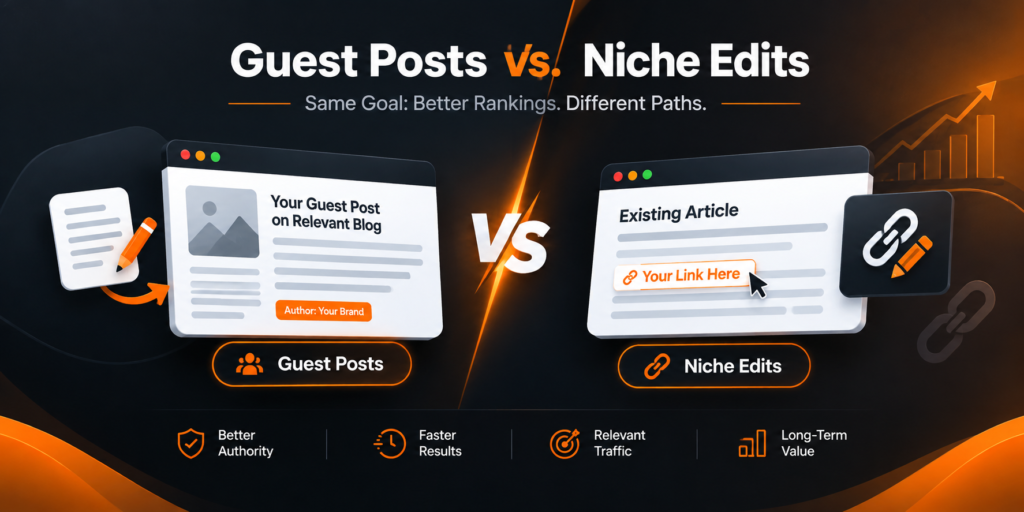
If you’ve spent any time building backlinks, you’ve run into this debate: should you pay for a guest post — a brand-new article written just to earn you a link — or a niche edit, where your link gets slotted into an article that’s already published, already indexed, and already ranking?
Both are everywhere in 2026. Both get pitched to agencies and business owners as “the better option.” And both, done badly, can waste your budget or put your site at risk.
Here’s the honest comparison — what each actually is, what changed after Google’s last major spam crackdown, and a simple framework for knowing which one your campaign actually needs right now.
What Is a Guest Post?
A guest post is a brand-new piece of content, written specifically to be published on someone else’s website, with a contextual link back to yours built into it. You (or your agency) pitch a topic, write the article to the publisher’s standards, and it goes live carrying your link, your anchor text, and your framing.
What you get:
- Full control over the surrounding content, context, and anchor text
- A new piece of content that can also drive referral traffic on its own
- A natural way to build a relationship with a publisher for future placements
- Genuine topical relevance, since you’re writing directly about your niche
The catch: a brand-new article has to earn its own rankings and traffic before it starts passing much authority — and writing, pitching, and editorial review all take time.
What Is a Niche Edit?
A niche edit — also called a link insertion — skips the content-creation step entirely. Instead of writing something new, you (or your outreach partner) find an existing, relevant, already-ranking article and get your link inserted into it, usually as an added sentence or resource mention.
What you get:
- Speed — there’s no waiting for new content to be written, published, and indexed
- A link placed inside a page that may already have real organic traffic and rankings
- Lower production cost, since no new article has to be written
The catch: you don’t control the rest of the page. If the surrounding content is thin, outdated, or sitting next to a pile of other paid links, your link inherits that risk. Publishers can also swap your anchor text or quietly remove the link later, since it’s not “their” content the way a guest post is.
Side-by-Side Comparison
| Factor | Guest Posts | Niche Edits |
|---|---|---|
| Speed | Slower — writing, pitching, editorial review | Faster — link goes straight into a live page |
| Cost | Higher (content production + outreach) | Lower (outreach + placement fee only) |
| Control | Full control over content, context, anchor text | Limited — you’re working inside someone else’s article |
| Traffic potential | New content can rank and earn its own traffic | Rides on the host page’s existing traffic, if any |
| Durability | Tends to last longer — it’s “their” content, less likely to be quietly edited out | Can be altered, buried, or removed without notice |
| Best for | Long-term authority, brand visibility, relationship building | Fast wins, filling gaps, time-sensitive campaigns |
What Changed for 2026: Quality Over Volume
Google’s spam-detection systems have gotten sharper about distinguishing real editorial placements from manufactured links. The practical effect: bulk guest posts on low-quality “write for us” sites and link-farm-style niche edits are increasingly a liability rather than an asset. A placement on a modest site with real organic traffic and genuine readers now consistently outperforms a high-authority-score domain that’s really just a shell for selling links.
That shifts the evaluation criteria for both tactics away from raw domain rating and toward:
- Real organic traffic on the page (not just the domain)
- Topical relevance to your niche, not just a passing mention
- Editorial legitimacy — does the site have actual standards, or does it accept anything for a fee?
This matters more for niche edits specifically, because a niche edit only works if the host page is genuinely alive — indexed, ranking, and getting visits. A niche edit dropped into a “zombie” page with high authority but zero real traffic does very little for you, no matter how good the metrics look on paper.
When to Choose Guest Posts
Guest posts are the better call when:
- You’re building long-term authority and want links that are still there in two years
- You want referral traffic, not just a ranking signal
- You’re in a relationship-driven niche — B2B, professional services, agencies — where an ongoing publisher relationship compounds in value
- You have the time and budget to produce genuinely good content, not just filler
When to Choose Niche Edits
Niche edits are the better call when:
- You need links fast, for a time-sensitive launch or campaign
- Budget is tight and you can’t justify full content production for every placement
- You’ve identified a specific, already-ranking page that’s a strong topical fit
- You’re filling a gap in an otherwise guest-post-heavy link profile for variety
The 2026 Verdict: Don’t Choose — Sequence Them
Treating this as an either/or decision is the outdated way to think about it. The link-building campaigns getting the best results in 2026 run both tactics in sequence rather than picking a side:
- Start with a mix of guest posts and niche edits on solidly relevant, real-traffic sites — this builds an initial base without over-relying on either method.
- Use niche edits for speed when you need to fill gaps quickly or respond to a time-sensitive opportunity.
- Use guest posts for compounding authority — they take longer to pay off, but they build the kind of topical depth and brand presence that a link insertion alone never will.
The quality bar is identical either way: real organic traffic on the placement, genuine topical relevance, and editorial legitimacy. A guest post on a spam-adjacent site is just as much a liability as a niche edit dropped into a dead page — the tactic itself was never the risk. Sourcing quality was.
Quick Decision Checklist
Before you commit budget to either tactic, ask:
- Does the host page/domain have real, verifiable organic traffic — not just a high authority score?
- Is the placement genuinely topically relevant, not just adjacent?
- For a niche edit: is the host article still actively ranking, or has it gone stale?
- For a guest post: does the publisher have real editorial standards, or will they accept anything for a fee?
- Does this placement fit a time-sensitive need (→ lean niche edit) or a long-term authority goal (→ lean guest post)?
Frequently-Asked Questions (FAQs)
Are niche edits riskier than guest posts?
Not inherently — the risk comes from where the link is placed, not the tactic itself. A niche edit on a genuinely active, relevant page is safer than a guest post on a low-quality content farm.
Do niche edits pass more link equity than guest posts?
They can, if the host page already has strong, established rankings and traffic — you’re borrowing authority that’s already been earned. A brand-new guest post has to build that authority from zero.
Which is better for a brand-new website?
Guest posts usually make more sense early on, since they also build referral traffic, brand visibility, and publisher relationships — not just a link.
Can I combine both in the same campaign?
Yes — and for most competitive niches, that’s the recommended approach: niche edits for speed, guest posts for durable, compounding authority.
How do I know if a site is a link farm rather than a real publisher?
Check for real organic traffic (not just a high authority metric), genuine editorial review, other non-paid content on the site, and whether the site would exist if it stopped selling placements.

Huzaifa Tahir is an SEO expert, blogger, and content writer passionate about creating engaging, informative, and search-engine-optimized content. He specializes in SEO strategies, blog writing, and content optimization to help websites improve their online visibility and reach a wider audience.