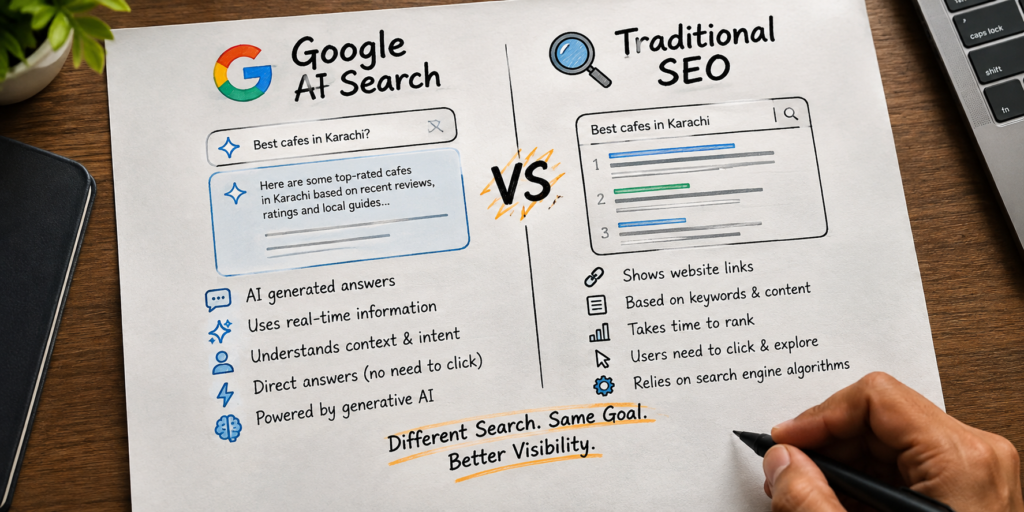
Search is not one thing anymore.
A few years ago, you typed a word into Google. You got ten blue links. You clicked one.
Today, that same search might show you an AI-written answer first. It might send you into a chat window called “AI Mode.” It might still show you the old ten links too — but lower down the page.
This guide breaks down the difference between Google AI Search and Traditional SEO in plain, simple words. No jargon. No confusing charts. Just what is happening, why it is happening, and what you should do about it.
What Is Traditional Search vs Google AI Search?
Let’s keep this simple.
Traditional Search is a librarian. You ask a question. It hands you a stack of books (websites) that might have your answer. You pick one and read it yourself.
Google AI Search is a research assistant. You ask a question. It reads the books for you. Then it gives you a short, direct answer — sometimes with a few book titles listed on the side, just in case you want to double-check.
That’s the whole shift in one sentence: Google used to point. Now Google also answers.
The 3 Faces of Google in 2026
Most people think “Google” is one thing. It’s actually three different experiences now, and each one behaves differently.
A. Traditional Search (the ten blue links) This is the classic search results page. Still used a lot, especially when people want to compare prices, check reviews, or find something nearby.
B. AI Overviews (the answer box at the top) A short AI-written summary that appears above the normal links for many searches. Good for quick facts like “how to remove a wine stain.”
C. AI Mode (the chat-style search) A full conversation with Google’s AI. You can ask a complex question, then ask a follow-up, then another follow-up — all without leaving the chat.
Think of it like this: Traditional Search is for finding. AI Overviews is for quick answers. AI Mode is for solving.
How Each One Actually Works (Explained Simply)
You don’t need to be a programmer to understand this. Here’s the basic idea, in plain words.
How Traditional Search works:
- Google sends out “robots” (called crawlers) that visit websites.
- It reads and saves what’s on each page.
- It stores everything in a giant filing cabinet called an index.
- When you search, Google pulls out the most matching pages from that cabinet and ranks them.
How AI Search works:
- The AI has “read” a huge amount of the internet during its training.
- When you ask a question, it doesn’t pull out one saved page like a filing cabinet. Instead, it predicts the best words to write, one word at a time, based on patterns it learned.
- Many AI tools also quickly search the live web first (this is called RAG — Retrieval-Augmented Generation), so the answer isn’t just from memory. It’s a mix of “what I learned before” and “what I just checked.”
Simple way to remember it: Traditional Search retrieves. AI Search generates. One gives you a list. The other gives you a written answer that was built just for your question.
The Big Comparison Table
| Factor | Traditional Search | AI Overviews | AI Mode |
| What you get | List of links | Short AI summary + a few links | Full chat conversation |
| Best for | Comparing, buying, local search | Quick facts | Complex, multi-part questions |
| Do people click away? | Yes, often | Rarely | Almost never |
| How Google decides | Ranking algorithm | Pulls from top-ranked pages | Reads broadly, sometimes goes beyond top 10 |
| What you should optimize for | Keywords + backlinks + page speed | Clear headings + direct answers | Being part of the “conversation” across the web |
| Content style that works | Structured, keyword-rich pages | Short answer blocks after each heading | Consistent facts everywhere (site, reviews, directories) |
Why Clicks Are Dropping (And Why That’s Not All Bad)
Here’s the honest truth: when an AI answer appears, fewer people click through to websites. This is called the “zero-click” problem.
But there’s a silver lining.
People who do click after seeing an AI answer are more ready to buy. They already read a summary. They already compared a few options. They land on your site already convinced — they just need the final push.
So yes, you may get fewer total visitors. But the ones who show up are often more serious. Less browsing, more buying.
What Makes AI Choose You? (The Real Ranking Signals)
This is the part everyone wants to know: how does AI decide who to mention?
Here’s what actually matters:
- Your traditional ranking still counts. Sites that already rank well on Google tend to get picked more often by AI tools too. Good old SEO is not dead — it’s the foundation.
- Being talked about everywhere matters more than one perfect page. AI doesn’t just read your website. It also learns from reviews, forums (especially Reddit), news articles, and other sites that mention you. If the whole internet agrees on who you are, AI trusts you more.
- Clear, structured content wins. Short paragraphs. Clear headings. Direct answers. Bullet points. Bold text. AI tools can “grab” this kind of content much more easily than a long, messy wall of text.
- Consistency beats confusion. If one site says your product costs $50 and another says $80, AI gets confused and may leave you out completely to avoid giving a wrong answer.
- Specific beats vague. A small business with detailed, specific reviews (example: “great for sensitive skin”) can beat a big brand that only has generic reviews.
SEO vs GEO: What Changes in Your Strategy
GEO stands for Generative Engine Optimization — basically, “SEO for AI answers.”
The good news? You don’t need two separate strategies. You need one strategy with an extra layer on top.
What stays the same (classic SEO):
- Keyword research
- Fast-loading pages
- Mobile-friendly design
- Backlinks from trusted sites
What you need to add for GEO:
- Turn your headings into questions (“How much does X cost?” instead of just “Pricing”)
- Add a short, direct answer right after each heading — 2 to 3 sentences max
- Add an FAQ section near the bottom of every important page
- List your pricing and limitations in plain text (not just inside a PDF or image)
- Get your business info to match exactly across your website, Google Business Profile, and review sites
- Ask happy customers for specific, detailed reviews — not just “great service!”
Real Example: How a Small Blog Got Quoted by AI
Let’s make this real with a simple, honest example.
Imagine a small local bakery blog writes a post titled “Best Gluten-Free Flour for Baking Bread at Home.”
Before: The post was one long paragraph. No headings. No bullet points. It ranked on page 2 of Google. Almost no traffic.
What they changed:
- Broke the post into clear sections: “Best Overall,” “Best Budget Option,” “Best for Beginners”
- Added a 2-sentence direct answer under each heading
- Added a simple FAQ: “Can I substitute regular flour 1-to-1?” with a short, clear answer
- Added a short review section with a specific customer quote
After: Within a few months, the post moved to page 1 of Google. Soon after, when people asked an AI tool “best gluten-free flour for bread,” the AI’s answer mentioned the bakery’s tip about “adding xanthan gum” — word for word, from their FAQ answer.
Why it worked: The AI could easily “grab” one small, clear, direct answer from their page. It didn’t need to read the whole article to find it.
The lesson: You don’t need to be a huge brand. You need to make your best information easy to find and easy to quote.
Your Step-by-Step Action Checklist
Use this list on any important page of your website.
- Write your main heading as a real question
- Add a 2-3 sentence direct answer right under that heading
- Break long paragraphs into short ones (3-4 lines max)
- Add bullet points wherever you’re listing more than 2 things
- Add an FAQ section with 4-6 real questions your customers ask
- Include your pricing in plain text somewhere on the page
- List what your product does NOT do (this helps AI recommend you for the right searches)
- Add at least one real customer quote or review with specific details
- Make sure your business name, address, and info match everywhere online
- Add schema markup if you can (or ask your developer to)
- Check your page speed and mobile view
- Re-check this list every 3 months — search keeps changing
Budget-Friendly Tips for Small Businesses and Bloggers
You don’t need expensive tools or a big agency to start. Here’s what you can do for free or cheap:
- Answer real questions people ask you. Look at customer emails, comments, and DMs. Turn those exact questions into FAQ sections.
- Ask for detailed reviews, not just stars. Send customers a simple message: “What specifically did you like?” Detailed answers help AI understand your strengths.
- Post honestly on Reddit or relevant forums (when it’s genuinely helpful, not spammy). AI tools read these a lot.
- Keep your Google Business Profile updated. It’s free and it directly feeds both traditional and AI search.
- Rewrite one old blog post per week using the checklist above, instead of always writing new content.
What’s Coming Next (2027-2028)
Search is moving toward AI “agents” that don’t just answer questions — they complete tasks for you. Example: instead of searching for shoes, you’ll tell an AI agent “buy me running shoes for flat feet, under $150, size 10,” and it will just do it.
For businesses, this means one thing: make sure your pricing, stock, and details are available in a simple, machine-readable way — not hidden inside images or PDFs. If a machine can’t read your information, it can’t recommend you.
Frequently-Asked Questions (FAQs)
Is traditional SEO dead?
No. It’s still the foundation. Sites that rank well on Google are far more likely to be recommended by AI tools too.
Do I need a different content strategy for AI search?
Not a different one — an extra layer on top of good SEO. Add direct answers, FAQs, and consistent facts across the web.
Will AI search replace traditional search completely?
Not soon. Many users still go back to traditional search to double-check what an AI told them, especially for big purchases.
Can small businesses compete with big brands in AI search?
Yes. AI often rewards specific, detailed, honest content over generic big-brand pages.
What’s the single easiest first step?
Add a short, direct 2-3 sentence answer under every important heading on your site. This one change helps the most, the fastest.
Key Takeaways
- Traditional Search gives you links. AI Search gives you answers.
- Google now runs three modes: Traditional Search, AI Overviews, and AI Mode.
- Ranking well traditionally still helps you get picked by AI.
- Clear structure (headings, short answers, FAQs) matters more than ever.
- Being talked about consistently across the whole internet matters as much as your own website.
- Small, specific, honest content can beat big, generic brand pages.
- Start small: rewrite one page at a time using the checklist above.

Huzaifa Tahir is an SEO expert, blogger, and content writer passionate about creating engaging, informative, and search-engine-optimized content. He specializes in SEO strategies, blog writing, and content optimization to help websites improve their online visibility and reach a wider audience.