

Most agencies don’t fail at white label SEO because the idea is bad. They fail because they picked the wrong partner.
When you resell SEO under your own brand, your partner’s work becomes your reputation. A missed deadline, a sloppy report, or a risky link on a client’s site lands on your desk, not theirs. And your client will never know (or care) that someone else did the work.
This checklist is built to help you choose carefully. Use it to screen providers before you hand over a single client. If you’re new to the model itself, start with what US agencies need to know about white label SEO in 2026, then come back here to evaluate partners.
What a Good White Label SEO Partner Actually Does
In a healthy white label relationship, the partner does the SEO work behind the scenes while you present it to your client under your own brand. You own the client relationship and set the price. They handle audits, on-page work, technical fixes, content, link building, and reporting.
The model only works when three things are true: the work is good, the process is invisible to your client, and the numbers leave you a real margin. The 12 points below test all three.
The 12-Point Checklist
They Follow White Hat Practices Only
This is the first filter, and it’s non-negotiable. Ask directly: What link sources do you use, and do you ever use private blog networks (PBNs)?
A PBN or bulk-link provider might show quick movement, but one bad link pattern can hurt a client’s site and your agency along with it. Look for partners who can explain their methods in plain language and who say no to shortcuts.
The Service Is Truly White Label
“White label” should mean more than a logo swap. Confirm that:
- Reports and dashboards carry your branding
- They sign an NDA before work starts
- They never contact your clients directly
- Any client-facing material is delivered to you first
If a partner hesitates on any of these, they’re not really white label. For a closer look at what a properly structured arrangement looks like, see our white label SEO partner program for agencies.
Pricing Is Transparent and Leaves You a Margin
You should know exactly what you’ll pay per client, per month, before you commit. A good rule of thumb: your wholesale cost should leave room for a healthy gross margin after you set your retail price. Among agencies we work with, many charge clients roughly $800 to $2,500 per month while paying a wholesale rate well below that, which leaves them 40% to 70% gross margin on each account.
Watch out for vague “custom pricing” with no ranges, and for hidden add-on fees that quietly erase your margin.
The Monthly Scope Is Written Down
“We’ll do SEO” isn’t a scope. Ask for a clear list of what’s included every month:
- On-page optimization
- Technical SEO fixes
- Keyword-targeted content
- Link building (and how many placements)
- Analytics and Search Console monitoring
- A branded monthly report
If the deliverables aren’t written down, you’ll end up arguing about them later, with your client in the middle.
Reporting Is Client-Ready
Your clients judge you by the report. Ask to see a sample. A good white label report shows rankings, traffic, and progress in plain language, and it’s ready to forward under your brand with minimal editing. Reports full of jargon and screenshots that you have to rewrite defeat the purpose of outsourcing.
They Respond Quickly and Deliver On Time
Test this before you sign. How fast do they reply to your first question? How long until they deliver a first audit once you send a client brief? A reasonable benchmark is a first audit within a few business days. Slow responses during the sales process rarely get faster once you’re a paying customer.
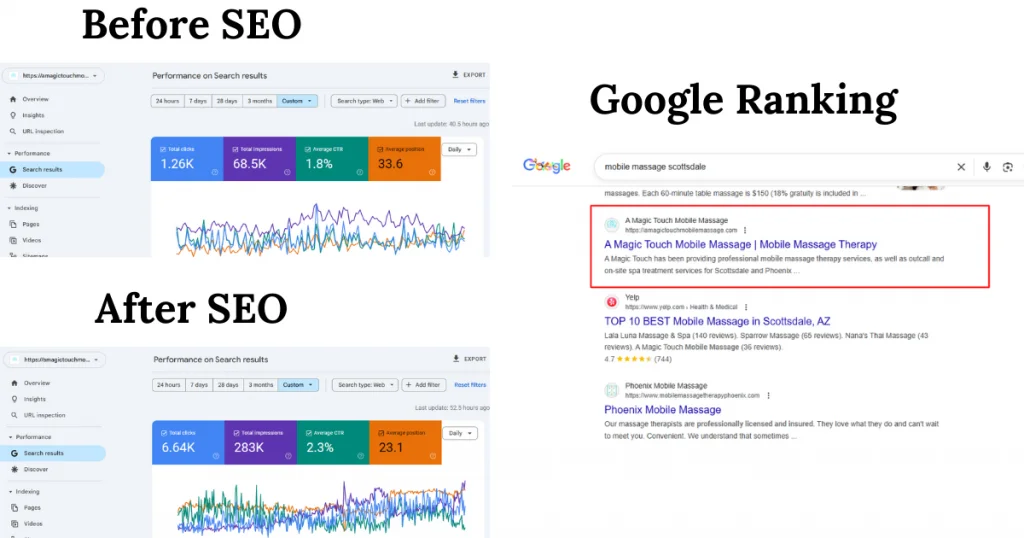
We helped a mobile massage company in the USA improve its Google rankings, organic traffic, and online visibility through a targeted SEO strategy. Within one year, the client achieved significant ranking growth and stronger search performance.
Their Link Building Is Explained, Not Hidden
Link building is where most white label problems start. Ask where the links come from and how they’re placed. A good partner can explain the difference between guest posts and niche edits and when each makes sense. If you want a primer, read our breakdown of guest posts vs. niche edits. Look for real sites with real traffic, relevant to your client’s industry, and not a bulk list of “DR 70+ links” with no context.
They Understand Your Clients’ Market
SEO in the US, UK, and Pakistan doesn’t behave the same way. Search behavior, competitors, and local signals differ. Ask whether the partner has worked in your clients’ markets and industries, such as law, healthcare, home services, or e-commerce. Agencies serving UK clients can also look at our guide to white-label guest posting for UK agencies.
If your partner is offshore, also check time-zone overlap. A few shared working hours each day make a big difference when a client emergency comes up.
They Can Scale With You
Starting with one client is fine. The real question is what happens when you sign five more. Ask how they handle growth: Do they have capacity? Is there a dedicated contact? Do they offer volume pricing as you add accounts? A partner that works well at one client and falls apart at five will cost you more than a slower, steadier one.
Contracts Are Flexible
Long lock-in contracts are a warning sign when you haven’t seen results yet. Look for month-to-month terms, no minimum client count, and a clear exit if a client leaves you. You should only pay for accounts you actually have.
The Team and Tools Are Current
Ask what tools they use for audits, tracking, and reporting, and who actually does the work. Also ask how they’re adapting to AI-driven search (AI Overviews and similar). Your clients are already asking about it, and your partner should have a point of view.
They’ll Prove Themselves Before You Commit
A confident partner welcomes scrutiny. Ask for sample reports, references, or a small pilot project on one low-risk client account. Reluctance to be tested is a red flag all by itself.
Quick Scorecard
Rate each partner from 1 to 5 on each point above. Anything below 3 on points 1, 2, or 7 should disqualify them, whatever their total.
| Area | What good looks like |
|---|---|
| White hat methods (1) | No PBNs, methods explained clearly |
| True white label (2) | NDA, your branding, no client contact |
| Pricing (3) | Clear rates, healthy margin |
| Scope (4) | Written monthly deliverables |
| Reporting (5) | Client-ready, branded |
| Speed (6) | Fast replies, first audit in days |
| Link building (7) | Real sites, explained process |
| Market fit (8) | Relevant experience |
| Scale (9) | Volume-ready, dedicated contact |
| Contracts (10) | Month-to-month |
| Team and tools (11) | Current tools, AI search aware |
| Proof (12) | Samples, references, pilot |
Red Flags to Walk Away From
- Guaranteed rankings or “#1 on Google” promises
- Bulk link packages with no site list
- No NDA, or reluctance to sign one
- Pricing that’s far below market with no explanation
- No sample report available
- Pressure to sign a long contract before a pilot
Run a 30-Day Pilot First
Don’t move your whole client base on day one. Pick one lower-risk client, set clear expectations, and run a 30-day pilot. Check three things: Did the partner deliver on time? Was the work quality consistent with what they promised? Did the report need little editing? If yes to all three, scale up. If not, you’ve lost a month rather than a client.
Ready to Evaluate a Partner?
If you’re comparing options, we’d be glad to be one of them. SEOKHI works with agencies as a fully white label partner: NDA first, your branding on every report, month-to-month terms, and no minimum client count. Learn more about our white label SEO agency in the USA, or talk to us directly and we’ll walk you through how a pilot would work.
Frequently-Asked Questions (FAQs)
What is a white label SEO partner?
A white label SEO partner is a company that performs SEO work for your clients behind the scenes, while you present and sell it under your own agency brand. You keep the client relationship; they handle the delivery.
How much does white label SEO cost?
It varies by scope and provider. Compare wholesale rates against what you can realistically charge clients, so you keep a healthy margin on each account. Always ask for pricing in writing before committing.
Will my clients know I’m outsourcing?
They shouldn’t. A proper white label partner signs an NDA, brands all reports with your name, and never contacts your clients directly.
How do I test a white label SEO provider safely?
Start with a 30-day pilot on one lower-risk client. Judge delivery speed, work quality, and how much editing the reports need before moving more accounts over.
Is a cheaper white label SEO provider worth it?
Be careful. Very low prices often mean bulk links, thin content, or hidden costs. A slightly higher rate for white hat work and reliable reporting protects both your clients and your agency.

Huzaifa Tahir is an SEO expert, blogger, and content writer passionate about creating engaging, informative, and search-engine-optimized content. He specializes in SEO strategies, blog writing, and content optimization to help websites improve their online visibility and reach a wider audience.