
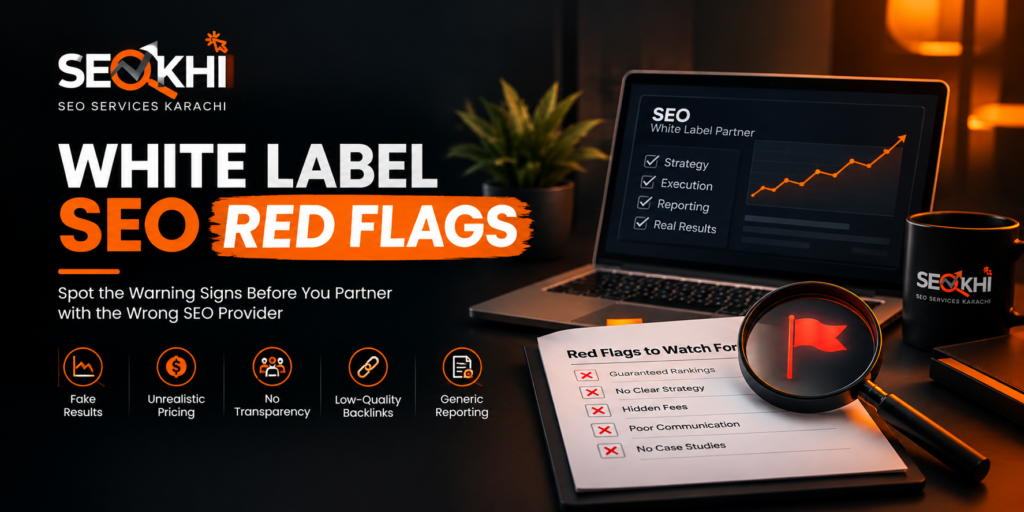
A bad white label SEO provider doesn’t just waste your budget. It costs you clients.
When you resell SEO under your own brand, every missed deadline, weak report, and risky link carries your agency’s name. Your client doesn’t know a partner did the work, and they won’t blame the partner when rankings drop. They’ll blame you.
The good news is that most bad providers give themselves away early, if you know what to look for. Here are nine red flags to catch before you hand over a single client. If you want the full evaluation framework, pair this article with our 12-point checklist for choosing a white label SEO partner.
Why Red Flags Matter More in White Label
In a normal vendor relationship, a bad supplier costs you money. In white label, a bad supplier costs you trust. You’re putting someone else’s work in front of your client under your name, often on a site that took your client years to build. Mistakes like spammy links or thin content can be slow to show up and slow to fix.
That’s why screening matters more than price.
The 9 Red Flags
They Guarantee Rankings
“Page one in 60 days, guaranteed.” “We’ll get you to #1.” Anyone who promises specific rankings is either misleading you or planning to use methods Google won’t like.
Why it hurts: Nobody controls Google’s results. Rankings depend on competition, the client’s site, and algorithm changes. A guarantee you pass on to your client becomes a promise you can’t keep.
What to ask: What do you commit to delivering each month, and how do you measure progress? A good partner promises deliverables and clear reporting, not positions.
They Won’t Explain Where Links Come From
Link building is where most white label damage happens. Red flags include bulk link packages (“50 links for $200”), vague answers like “high-authority sites,” no list of placement sites, and open use of private blog networks (PBNs).
Why it hurts: Google’s spam policies treat manipulative link schemes as a violation. A pattern of low-quality links can suppress a client’s rankings, and cleaning it up takes months.
What to ask: Can you show me example placements, and what are your standards for the sites you use? Look for real sites with real traffic and relevance. If you want to understand what legitimate link placement looks like, see our breakdown of guest posts vs. niche edits.
The Price Is Too Good to Be True
If a provider charges a fraction of what comparable partners charge and can’t explain why, something is being cut. Usually it’s content quality, link quality, or the hours spent on your accounts.
Why it hurts: Low prices tempt you to build a big margin, but you’ll pay for it later in churn and cleanup. Low prices can be legitimate (for example, a lean team with lower operating costs), but the provider should be able to explain how, and show their work. Compare any quote with the ranges in our guide to white label SEO pricing in 2026.
What to ask: What exactly is included at this price, and what would cost extra?
There’s No NDA, and They Break the White Label Wall
A real white label provider signs a non-disclosure agreement, delivers work under your brand, and never contacts your clients directly. Warning signs include no NDA, reports with the provider’s logo on them, emails sent directly to your client, or hesitation when you raise confidentiality.
Why it hurts: The moment your client learns who actually does the work, your positioning and your margin are at risk. It can also expose the client relationship you spent years building.
What to ask: Do you sign an NDA before work begins, and how do you handle client communication?
You Can’t See a Sample Report, or You Can’t Forward the Reports You Get
Reports are what your client sees every month. If a provider has no sample, or their reports are packed with jargon and screenshots you’d need to rewrite, you’ll spend your margin on editing.
Why it hurts: A confusing report makes the work look weaker than it is, and it makes renewals harder.
What to ask: Can I see a sample report, and is it ready to send under my brand?
The Scope Is Vague, the Fees Are Hidden, and the Contract Is Long
“We’ll handle your SEO” is not a scope. Watch for unclear deliverables, setup fees that appear after you agree, extra charges for basic reports, and long lock-in contracts before you’ve seen any results.
Why it hurts: Vague scope leads to arguments, and arguments land in front of your client. A long contract with a weak provider means paying for months of work you can’t use.
What to ask: Can I have the monthly deliverables in writing, a list of all one-time and recurring fees, and month-to-month terms?
Communication Is Slow or Vague
If it takes days to get a reply during the sales process, it won’t improve once you’re paying. Warning signs include no single point of contact, answers that avoid the question, and no stated turnaround time for audits or fixes.
Why it hurts: When a client emails you with a problem, you need an answer the same day. A provider who can’t give you one leaves you exposed.
What to ask: Who is my day-to-day contact, and how fast do you reply? Test it before signing.
The Content Is Mass-Produced and Unedited
Thin, templated articles stuffed with keywords, or raw AI output published with no editing or fact-checking, are a growing problem. Look for identical structure across different clients, generic advice, and no subject research.
Why it hurts: Google’s spam policies target large-scale, low-value content. Weak content doesn’t rank, and at scale it can drag down a whole site.
What to ask: Who writes and edits the content, and what is your quality-control process?
They Lock You Out of Your Clients’ Data
Your client’s analytics, Search Console, and site access should belong to your client, and you should be able to see them. Red flags include a provider who insists on running everything through their own accounts, refuses to share access, or won’t hand over assets if you leave.
Why it hurts: If the relationship ends and the data is stuck with the provider, you lose your history, your proof of results, and sometimes your client.
What to ask: Will all accounts stay in my client’s name, and what do I receive if we part ways?
Quick Screening Table
| Red flag | Safe response to look for |
|---|---|
| 1. Guaranteed rankings | Commits to deliverables and reporting, not positions |
| 2. Mystery links | Explains sources and shows example placements |
| 3. Too-cheap pricing | Explains what’s included and why the price is lower |
| 4. No NDA | Signs an NDA first; never contacts your clients |
| 5. No sample report | Shows a client-ready, brandable sample |
| 6. Vague scope | Written monthly deliverables, month-to-month terms |
| 7. Slow communication | Named contact and stated reply times |
| 8. Mass-produced content | Human-edited, researched content |
| 9. Data lock-in | Accounts stay in the client’s name |
What a Good Partner Looks Like
A trustworthy partner is the mirror image of this list. They explain their methods, sign an NDA before they start, put the scope and pricing in writing, deliver reports you can forward under your brand, and let you test them first. That’s the standard we build to at SEOKHI, and it’s what you should expect from anyone you evaluate. See how we structure it in our white label SEO partner program for agencies.
Already Working With a Provider Showing These Signs?
You don’t have to start from scratch, but act early:
- Get access. Make sure analytics and Search Console are in your client’s name and you can see them.
- Request a full list of links built. Ask for URLs and dates, then review quality yourself.
- Audit before you react. Not every weak link needs removal. Focus on clearly spammy placements, and ask for removal first.
- Review recent content. Check whether published pages are accurate, original, and useful.
- Run a pilot with a better partner. Move one low-risk client first, and compare results before moving the rest.
Want a Partner That Passes This Test?
If you’re comparing providers, we’d be glad to be one of them. SEOKHI works as a fully white label partner: NDA first, your branding on every report, month-to-month terms, and no minimum client count. Learn more about our white label SEO agency in the USA, or contact us to talk through a pilot on one client account.
Frequently-Asked Questions (FAQs)
What are the biggest red flags in a white label SEO provider?
The most serious are guaranteed rankings, unexplained link sources, no NDA, and a refusal to share data or sample reports. Any one of these is reason to pause. Several together mean you should walk away.
Can a bad white label provider hurt my client’s rankings?
Yes. Manipulative links or thin, mass-produced content can suppress a site’s rankings, and cleanup can take months. That’s why screening providers before you start matters.
How can I check the quality of the links a provider builds?
Ask for a list of placement URLs, then check whether each site has real organic traffic, relevant content, and genuine editorial standards. Avoid sites that exist mainly to sell links.
Is cheap white label SEO always a red flag?
No, but unexplained low pricing is. A lean, lower-cost team can offer fair prices, as long as the provider can clearly explain what’s included and show sample work.
What should I do if I’m already using a provider with these red flags?
Secure access to your client’s accounts, request a full list of links built, audit the work, and pilot a better partner on one low-risk client before moving others.

Huzaifa Tahir is an SEO expert, blogger, and content writer passionate about creating engaging, informative, and search-engine-optimized content. He specializes in SEO strategies, blog writing, and content optimization to help websites improve their online visibility and reach a wider audience.